What That Vintage Piece Is Trying to Tell You (If You Know How to Listen)
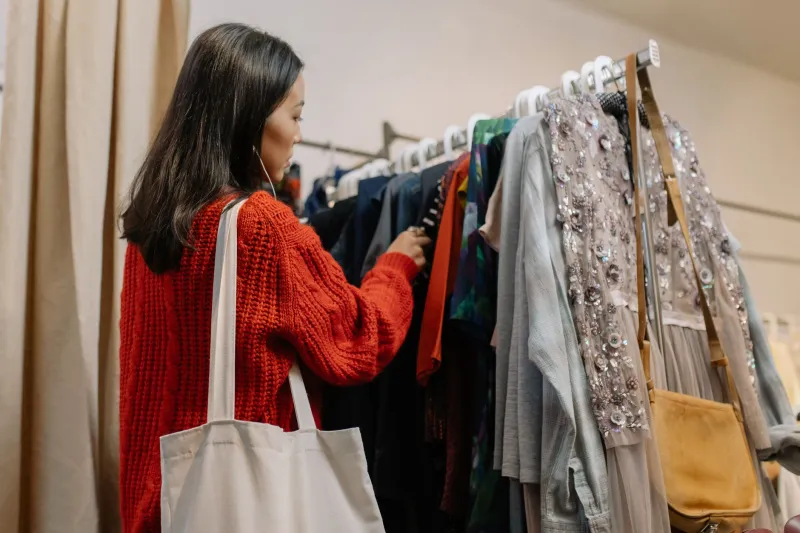
You're standing in the aisle of a Goodwill somewhere in Ohio, holding a blazer that feels different. Heavier than it should be. The lining has this almost architectural quality to it. The buttons are real horn, not plastic — you can tell because they're slightly irregular, slightly warm to the touch. Something in your gut says this matters, but you're not sure why.
That instinct? It's not random. Your hands are picking up on a language that most modern shopping has trained us to ignore. Vintage and secondhand clothing carries coded information — in its labels, its seams, its materials, its construction — and once you start learning to read it, you'll never browse a thrift rack the same way again.
This isn't just about finding a "good deal." It's about understanding provenance: where a thing came from, who made it, and what that means for how long it'll last in your wardrobe. At Falake Shop, we talk a lot about the story behind what you wear. Vintage is where that conversation gets really interesting.
Start With the Label — But Read Between the Lines
The care label is your first clue, and not just for washing instructions. In the US, the Federal Trade Commission didn't require permanent care labels in garments until 1971. So if a piece has no care label at all, or the label is woven directly into the garment rather than printed on a separate tag, you're likely holding something made before that era. That's not a red flag — it's a timestamp.
Union labels are another goldmine. If you spot a small tag from the ILGWU (International Ladies' Garment Workers' Union) or the ACWA (Amalgamated Clothing Workers of America), you're holding a piece made by American workers under regulated conditions — often between the 1930s and 1970s. These labels were a point of pride, not an afterthought. The specific local number printed on the tag can even help you trace the region where it was made.
Country-of-origin labels became mandatory in the US in 1971 as well. "Made in USA" tags from before the 1980s often indicate domestic manufacturing at its peak — before offshoring gutted the industry. "Made in Western Germany" or "Made in Czechoslovakia" are geographic tells that immediately date a piece to before reunification or the fall of the Soviet bloc.
The Seam Is the Signature
Flip the garment inside out. This is where mass production and intentional making part ways completely.
In quality vintage construction — especially pre-1980s — you'll often find flat-felled seams, where the raw edge is folded over and stitched down on both sides. It takes more time, more skill, and it lasts significantly longer. You'll also see French seams on delicate fabrics: a clean, enclosed finish with no raw edges exposed at all. These techniques weren't just aesthetic choices. They were the standard for anyone who expected a garment to survive decades of wear.
Contrast that with the serged-only seams you find on most fast fashion today — a single pass of an overlock machine that does the job quickly but leaves the construction vulnerable over time. When you see serging alone on a vintage piece, it's a sign you might be looking at something from a lower price point even in its original era.
Also look at stitch density. More stitches per inch generally means stronger construction. Run your finger along a seam and feel whether it's taut and even, or slightly puckered and loose. Handmade or couture-adjacent pieces will often have almost imperceptible stitching — fine, close, and consistent in a way that modern machines still struggle to replicate at scale.
Materials Don't Lie
Fabric content is one of the most honest things a vintage piece can tell you. Natural fibers — wool, silk, linen, cotton — dominated garment production before the synthetic revolution of the 1960s and 70s. Finding a blazer in heavy wool crepe or a blouse in true silk charmeuse often signals age and quality simultaneously.
Here's a quick field test: the burn test. Pull a single thread from an interior seam (somewhere invisible) and hold it to a flame. Natural fibers burn cleanly and smell like burning hair or paper. Synthetics melt, bead up, and smell chemical. A blend will do both. This isn't something you can do in-store, obviously — but when you get a piece home and you're trying to understand what you've got, it's invaluable.
Hardware is another material tell. Metal zippers, especially those marked "Talon" or "Conmar," are distinctly American and date mostly to the mid-20th century. YKK became dominant globally by the 1970s. A heavy brass zipper that slides with that particular smooth resistance? You're probably holding something with serious age and serious quality.
Pattern Matching as Craft Evidence
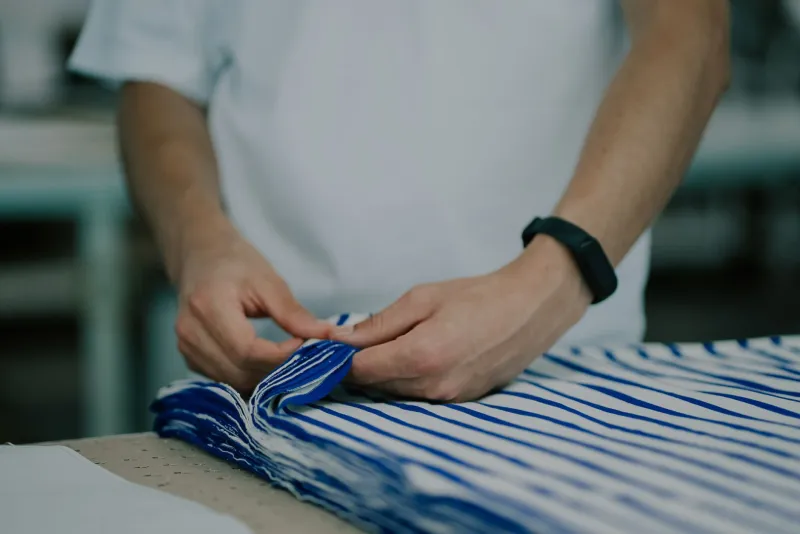
One of the clearest markers of intentional making — whether in vintage or contemporary artisanal work — is pattern matching at the seams. Stripes that align perfectly across a side seam, plaids that continue without interruption from body to sleeve: this is time-consuming work that manufacturers cut first when margins get tight.
If you're holding a plaid blazer and the pattern runs continuous from front panel to pocket flap, someone cared. Someone cut each piece individually, checked the alignment, and sewed with intention. That's not mass production logic. That's craft logic.
Putting the Story Together
Once you've gathered your clues — the label era, the seam construction, the material content, the hardware, the pattern work — you can start to build a picture. Not just of what you're holding, but of who made it and under what conditions.
A 1950s wool suit with union label, flat-felled seams, and perfectly matched plaid isn't just a vintage find. It's a document. It's evidence of an American garment industry that once employed millions of skilled workers, of manufacturing standards that prioritized longevity over margin, of a time when the person who bought this suit expected to wear it for twenty years.
That context doesn't just make the piece more interesting. It makes it more valuable — in every sense of the word. When you wear something with that kind of provenance, you're not just wearing a jacket. You're wearing a point of view.
The Thrift Store as Archive
We tend to treat secondhand shopping as either a budget move or a sustainability flex. Both of those things are true, and neither is the whole story. Vintage shopping, done with real attention, is also an act of cultural literacy. It's learning to read the material record that mass consumerism has trained us to overlook.
Next time you're at the Salvation Army, the estate sale, the vintage market on a Saturday morning — slow down. Flip the collar. Check the seams. Read the label like it has something to say. Because it does. Every garment that survived long enough to end up in someone else's hands has already proven something about itself.
The question is whether you're paying attention.