Handmade Doesn't Mean Hit-or-Miss: How Independent Makers Are Rewriting the Rules of Clothing Quality
There's a stubborn myth floating around the fashion world that goes something like this: handmade clothes are charming, sure, but consistent? That's what factories are for. It's a narrative that's served big apparel corporations well for decades. And it's almost entirely wrong.
The truth is, many of the quality standards that once defined American and European garment-making—tight seam allowances, hand-finished edges, fabric tested before a single stitch is sewn—were quietly abandoned somewhere between the race to offshore production and the rise of $12 dresses. What we lost wasn't just craftsmanship. We lost accountability.
Now, a new generation of independent designers and small fashion houses is reclaiming that accountability, stitch by stitch. And they're not just matching old standards. In many cases, they're surpassing them.
When the Industry Stopped Caring, Artisans Didn't
Walk into the studio of a small-batch maker—say, a Brooklyn-based knitwear designer or a New Mexico weaver producing natural-dye wool pieces—and you'll notice something immediately: there are systems everywhere. Notebooks documenting fabric lot numbers. Swatches pinned next to finished pieces for comparison. Wash tests run before anything ships.
This isn't precious or performative. It's how quality actually gets maintained when you don't have a corporate compliance department rubber-stamping minimums.
For many independent makers, quality control isn't a department—it's a philosophy baked into every decision. When Portland-based slow-fashion designers talk about their process, they often describe something that sounds more like fine woodworking than apparel production: choosing materials based on hand-feel and structural integrity, not just price point, and building in time to actually examine what they've made before it leaves their hands.
That's a stark contrast to fast fashion's standard operating procedure, where speed-to-market pressure routinely results in fabrics chosen from digital spec sheets, seams finished to the legal minimum, and quality checks that amount to a quick visual scan on a conveyor belt.
Sourcing as a Quality Standard
One of the most underappreciated aspects of artisanal quality is what happens before any sewing begins. Material sourcing, for independent makers, is often where the real quality conversation starts.
Many small designers work directly with mills—sometimes mills that have been producing specialty textiles for generations. They're choosing fabric based on thread count, weave density, fiber origin, and how a cloth behaves after repeated washing. Some are visiting farms. Some are commissioning custom weaves. The point is: they know exactly what they're working with.
This matters enormously for durability. A linen shirt made from long-staple flax processed slowly will wear completely differently than one made from short-fiber linen processed fast and cheap. You can't see that difference on a hanger in a store. You absolutely feel it after two years of wear.
Artisanal makers also tend to buy in smaller quantities, which means they can afford to be selective—and they can't afford to get it wrong. When you're producing 50 pieces instead of 50,000, a bad fabric choice is a disaster, not a rounding error.
The Seam Allowance Nobody Talks About
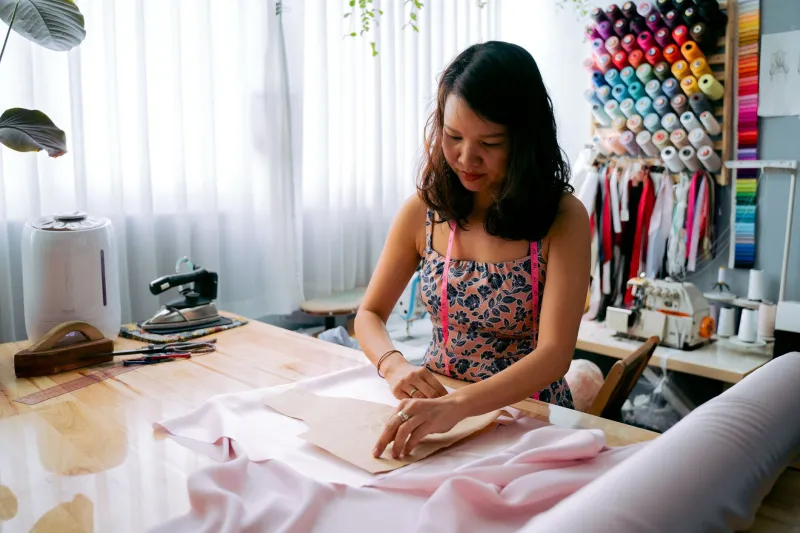
Here's a very unglamorous detail that separates a garment built to last from one built to sell: seam allowance. The extra fabric left beyond the stitch line determines whether a garment can be let out, repaired, or reinforced over time. Standard fast fashion seam allowances have shrunk dramatically over the decades—sometimes to as little as a quarter inch—making alterations nearly impossible and repairs structurally weak.
Many artisanal makers build in half-inch to five-eighths-inch seam allowances as a baseline. Some go further on tailored pieces. It's a small thing. It adds a little material cost. And it's the difference between a jacket you can wear for fifteen years and one you replace in three.
Similarly, finishing methods matter. A serged edge (the looping stitch that prevents fraying) done on a commercial overlock machine is fine. A hand-bound buttonhole is extraordinary. French seams on a blouse mean the inside of the garment looks as considered as the outside—and structurally, the fabric is enclosed rather than exposed, dramatically extending the life of the piece.
These aren't lost arts. They're choices. And independent makers are choosing them.
Transparency as a Quality Signal
One of the most telling differences between artisanal production and corporate manufacturing is how readily makers talk about their process. Ask an independent designer where their fabric comes from, and you'll typically get a real answer. Ask a fast fashion brand the same question and you'll get a sustainability report written by a PR team.
This transparency isn't just feel-good storytelling. It functions as a quality signal. When a maker can trace their wool to a specific ranch in Colorado, or their silk to a cooperative in a specific region, that traceability reflects the kind of intentional sourcing that produces better garments. Supply chain opacity, on the other hand, is often a symptom of supply chain shortcuts.
Some small makers are now publishing what you might call quality manifestos—detailed breakdowns of their construction standards, material benchmarks, and the specific reasons they make certain choices. It's radical transparency in an industry that has historically hidden everything behind a logo.
What This Means for Your Wardrobe
If you've ever bought something handmade and been disappointed—a seam that puckered, a dye that ran, a fit that just wasn't right—that experience is real and valid. Not every independent maker is executing at a high level. The field is genuinely varied.
But the solution isn't to retreat to mass production. It's to get better at identifying makers who have built real systems around quality—who can tell you exactly how their garments are constructed and why, who stand behind their work with repair policies or guarantees, and whose pieces you can examine for the small details that reveal big commitments.
Look at the inside of a garment as carefully as the outside. Ask about the fabric. Notice how the buttons are attached, whether the pattern matches at the seams, how the hem is finished. These aren't fussy concerns. They're the vocabulary of quality that the garment industry spent decades training consumers to forget.
The makers who are reclaiming these standards are doing something quietly radical. They're proving that clothing can be both handcrafted and rigorously consistent—that care and quality aren't opposites of scale, they're the foundation of it. And every piece built to those standards is a small argument for a fashion industry that actually deserves our trust.